
August 25, 2026
The prediction instinct is worth billions. It doesn’t have to be gambling.
How the fan-engagement opportunity hiding inside the betting boom lets rights-holders capture the same behaviour, and own the data it produces.
Updated: September 2026
There is a multi-billion-dollar business built on a single human instinct: I think this team wins. I think this player scores first. The betting industry has spent decades monetising that instinct, and right now it’s fighting a very public, very expensive battle over who gets to regulate it.
But the instinct itself isn’t gambling. It only becomes gambling when you attach a wager and a payout. Strip those away, and what’s left is one of the most powerful engagement drivers in sport, and it belongs to the rights-holder, not the operator.
This is the opportunity most clubs, leagues and sports media companies are walking past.
The boom – and the war being fought over it
The scale of the prediction market is no longer in question. It’s being proven, in public and in court.
The names driving it are now familiar ones: Kalshi and Polymarket have turned event contracts into a mainstream product, DraftKings and FanDuel have moved in with prediction markets of their own, and exchanges like Smarkets are racing to follow – with sport a primary driver of volume across all of them.
And it’s no longer a fringe product. For the 2026 World Cup, FIFA named an official prediction market partner – the category now has a seat at the biggest table in world sport. The model has arrived. The only open question is who gets to run it, and under what rules.
Consider the scale of a single player. UK betting exchange Smarkets has over $60 billion in lifetime trading volume and collected more than $1.2 billion this year alone. It’s now pursuing a “dual-track” entry into the U.S. – applying for a federal prediction-market licence and state-by-state sportsbook licences at the same time, because even the operators aren’t certain which rules apply. The pull is strong enough that FanDuel’s parent company has noted its prediction platform can acquire customers faster in states where sportsbooks are still under scrutiny.
Meanwhile, the regulatory ground is shifting under all of them. A growing number of U.S. states argue prediction markets are operating as unlicensed gambling. The federal Commodity Futures Trading Commission has sued multiple states to block those efforts. Last month, 44 state attorneys general wrote that the CFTC cannot be the exclusive regulator of sports-event contracts. Every operator faces compliance and tax costs that stack up state by state, country by country.
Billions in volume. A federal agency on one side, dozens of attorneys general on the other. That’s not a sign of a fragile market – it’s a sign of an enormous one. The demand is real; it converts, and everyone can see it.
The instinct underneath
Here’s the part that gets lost in the legal noise.
The reason all of this works, the reason there’s $60 billion of volume to fight over, is not the wager. It’s the prediction. The wager is just the mechanism the betting industry uses to monetise it.
The instinct to predict is native to being a sports fan. It’s why people argue about line-ups before kick-off, why they call the final score in the first quarter, why a close game is unbearable to look away from. That instinct drives attention, repeat visits, and appointment-to-view behaviour whether or not a single euro is ever staked.
Gambling is one way to monetise that instinct. It is not the only way. And for a rights-holder, it’s not even the most valuable one – because the betting model gives the fan’s data and the fan’s relationship to the operator, not the club.
“So it’s like Polymarket?” — a game is not a market
Since this was first published, one question now comes up in almost every conversation with a rights-holder: “So it’s like Polymarket?”
It’s a fair question — because the word “prediction” is suddenly doing double duty, and the two things it now describes sit on opposite sides of the fork.
Kalshi and Polymarket are prediction markets. The fan puts real money on an outcome and can win or lose it. It’s a financial product, and it carries everything that comes with one: a licence in every market, and the fan’s data sitting with the operator.
A UseAward prediction game is the other side. Free-to-play, no wager, no payout. Fans predict for points, prizes and status — the same instinct, the same data feeds, the same loop — but no money ever changes hands. It’s a fan-engagement product, and the data it produces belongs to the club.
So, to be precise: a prediction game is not a prediction market. A prediction market is a place to stake money on a result. A prediction game is a way for a rights-holder to capture the prediction instinct, reward fans for it, and own the first-party data it produces. That single word — market versus game — carries the whole fork with it: licence or no licence, the operator’s data or yours, betting sponsors only or any sponsor at all.
Same foundation, different destination
The most honest way to understand the two models is to see how much they share.
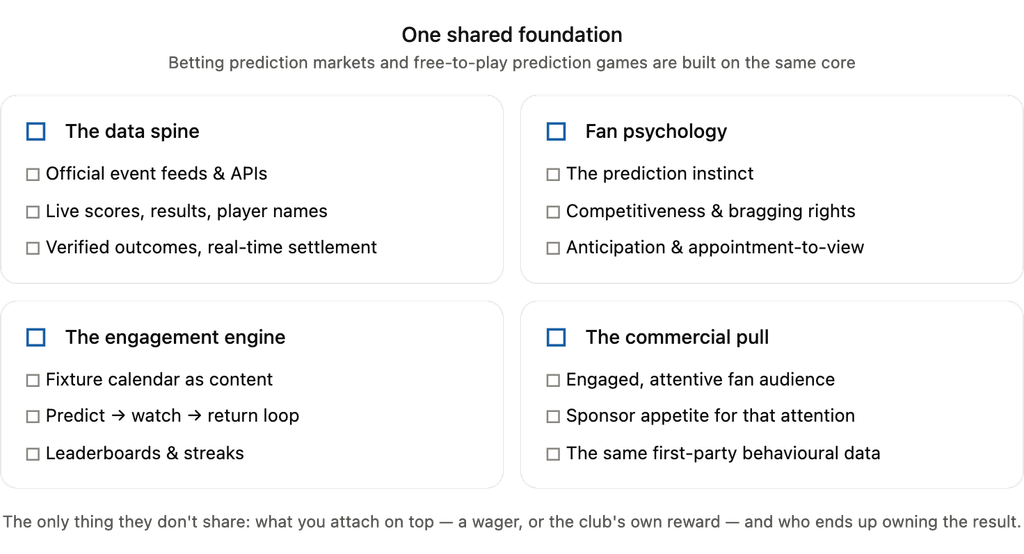
A betting prediction market and a free-to-play prediction game run on an almost identical foundation:
- The same real-world data — live scores, results, player names, verified outcomes, all pulled from the same official event feeds and APIs.
- The same prediction instinct — “I think this team wins” is the entry point for both.
- The same engagement loop — predict, watch, the outcome resolves, come back for the next fixture.
- The same fixture calendar as the content engine — every match on the schedule is a fresh prediction moment.
- The same competitive layer — leaderboards, streaks, rankings, bragging rights.
- The same appointment-to-view payoff — a prediction gives a fan a reason to watch live, not catch the highlights later.
- The same audience — engaged sports fans, doing what engaged sports fans do.
Two products, one spine. They are far more alike than the regulatory conversation makes them sound.
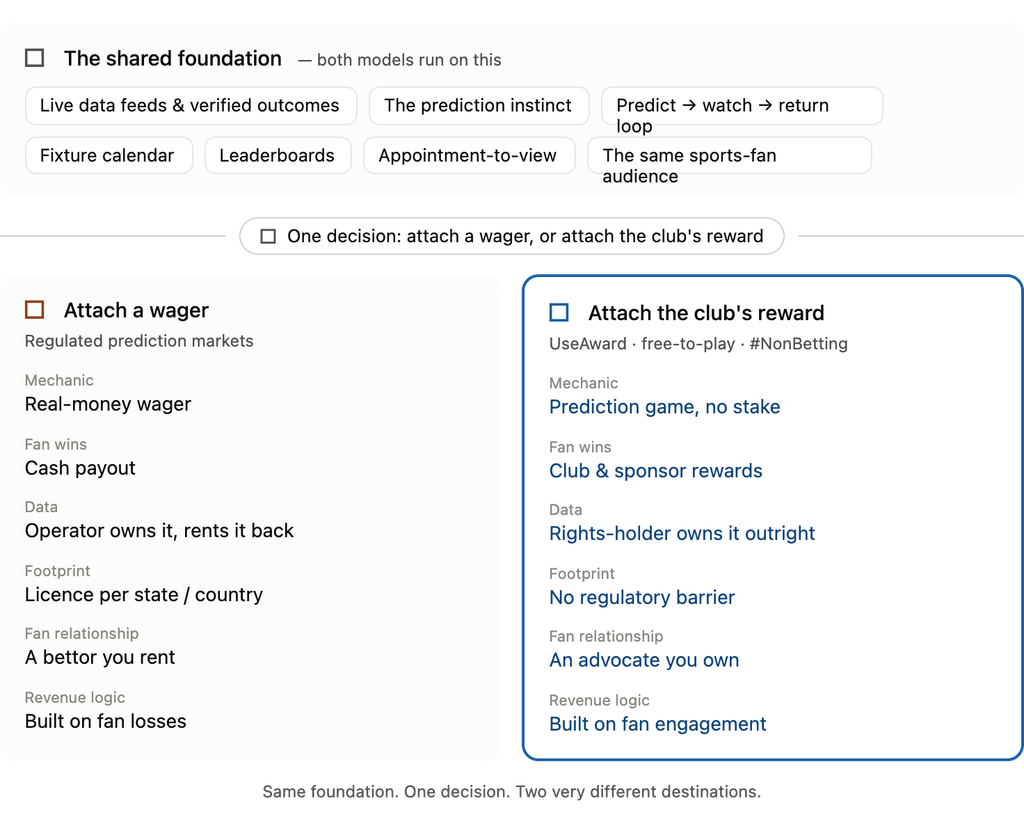
The fork: one decision splits the road
Everything the two models share runs up to a single decision point. And that one choice determines everything downstream.
Attach a wager, and you’re in the regulated world: real-money stakes, cash payouts, a licence required in every state and country you operate in, first-party data owned by the operator and rented back to the rights-holder, and a business model that ultimately depends on fans losing.
Attach the club’s own reward instead, and the same engagement loop becomes something else entirely: free-to-play with no stake and no payout, rewards delivered by the club and its sponsors, no regulatory barrier to clear, and – critically – every prediction becomes a first-party data point the rights-holder owns outright.
Same instinct. Same loop. Same data feeds. One fork. Two completely different outcomes for the organisation running it.
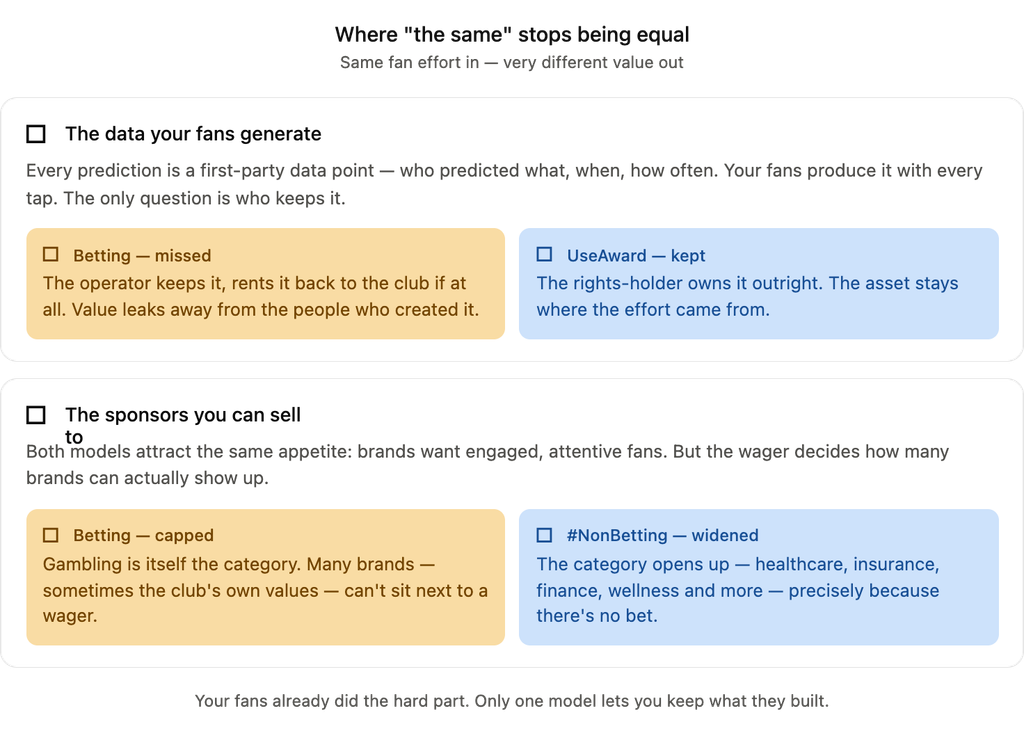
This is the lane UseAward is built for: the free-to-play prediction game that captures the exact fan behaviour driving those billions in betting volume – cleanly, with no licence in every market, and with the data staying where it belongs.
The opportunity — and why now
Put the two halves together, and the market potential becomes obvious.
The betting industry has already proven, at billion-dollar scale, that the prediction instinct converts. That’s the demand side, validated in public. At the same time, regulation is actively capping who can serve that demand and how – licence by licence, lawsuit by lawsuit, jurisdiction by jurisdiction.
That combination leaves a wide, open lane: enormous, proven appetite for prediction-based engagement, and a regulated route to it that most rights-holders can’t or shouldn’t take.
For a club, league or media company, the free-to-play route captures the same behaviour, the engagement, the repeat visits, the appointment-to-view moments, without any of the regulatory exposure. And it does something the betting model never will: it turns every prediction into first-party data the rights-holder owns. That’s an audience you own, not one you rent. It’s sponsor inventory you control. It’s a fan relationship that belongs to you.
The prediction instinct isn’t going anywhere. The only real question is who captures it, and who owns what it produces.
Frequently asked
Is a prediction game gambling?
A non-betting prediction game is not gambling. There is no wager and no payout — fans play free-to-play, for points and prizes rather than money. Gambling requires something of value staked on an outcome; a non-betting prediction game removes exactly that.
What’s the difference between a prediction game and a prediction market?
A prediction market — such as Polymarket or Kalshi — is a real-money marketplace where participants take financial positions on outcomes. A non-betting prediction game involves no money at all: it’s an engagement product that generates first-party data for the rights-holder, not a financial position for the fan.
Do prediction games need a gambling licence?
Because a free-to-play prediction game involves no wager, it does not carry the licensing, age-gating and advertising restrictions that apply to betting and real-money markets. (Regulations vary by jurisdiction, so specifics should always be confirmed locally.)
Which sponsors can back a prediction game?
Any category. Because it isn’t a betting product, a non-betting prediction game is a clean, brand-safe surface open to every sponsor — not locked to the gambling category, and unlikely to conflict with a rights-holder’s existing partners.
Why does first-party data matter to a club or league?
It’s the difference between owning your audience and renting it. First-party data — collected directly, with consent, through your own engagement — stays with the rights-holder, powers sponsor activations, and doesn’t disappear when a third-party deal ends.
Same instinct. Two very different choices.
The betting industry is spending billions fighting over who gets to regulate the prediction game.
Rights-holders have a simpler option: keep the instinct, drop the wager, and own the result.
Same instinct – one model monetises the risk, the other monetises the engagement.
UseAward is an engagement-as-a-service platform that helps sports teams, leagues, media companies and brands activate their fanbases through prediction games, polls, challenges and rewards – while capturing first-party data they own. UseAward is an IBM Silver Business Partner.
#NonBetting