June 26, 2026
How BK Ventspils Built Its First Real Fan Database
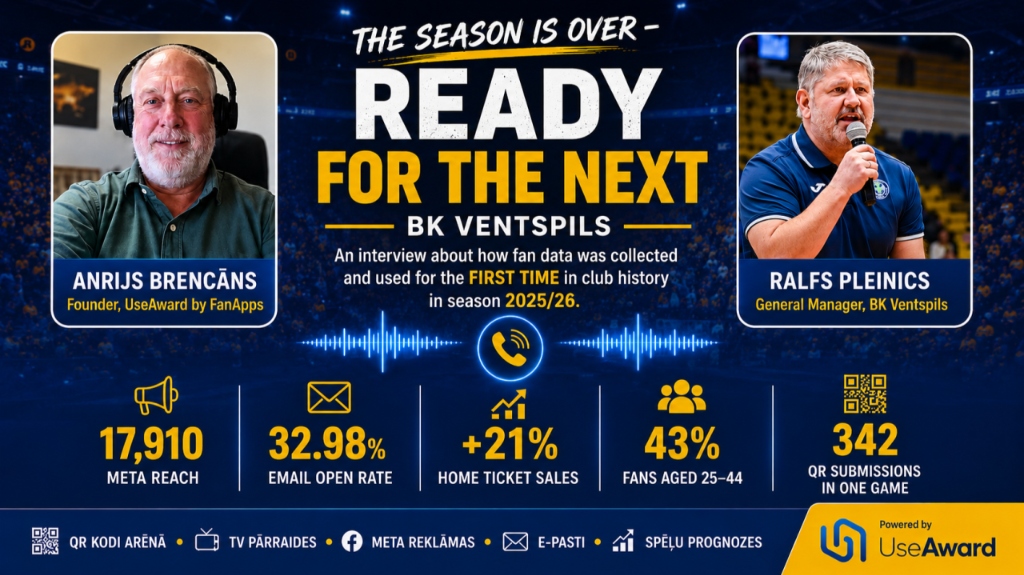
How BK Ventspils built its first real fan database — a conversation with GM Ralfs Pleinics and FanApps CEO Anrijs Brencāns.
THE CONTEXT
BK Ventspils is the most decorated basketball club in Latvia, a 10-time national champion with a loyal and passionate fanbase. Yet like most sports clubs in the region, they faced a challenge that is universal across the industry: packed arenas, but no direct relationship with the fans inside them. Tickets sold through third-party platforms meant zero first-party data. Fans were anonymous. Marketing relied on a broad social media reach with no way to segment, retarget, or measure true conversion to revenue.
Ventspils and its surrounding region have a total catchment population of approximately 50,000 people, a small, diverse community… This is not a major metropolitan market. There is no large untapped audience to simply throw advertising budget at. Every fan contact matters. Every data point has real value.
In the 2025/26 season, BK Ventspils partnered with UseAward to change that — running 13 fan engagement campaigns across META paid ads, arena QR codes, TV broadcasts, and email. What follows is a conversation between Anrijs Brencāns (UseAward) and Ralfs Pleinics (BK Ventspils GM) about what worked, what surprised them, and what the numbers actually mean.
THE INTERVIEW
Anrijs Brencāns: Ralfs, before we started this project, what was the biggest frustration from a management perspective when it came to your fans?
Ralfs Pleinics: Honestly, it was the invisibility. We’d have 1,500 people in the arena, the atmosphere would be incredible, and I knew almost nothing about those people. Not their age, not their email, not whether they’d been once or fifty times. We were selling tickets through a platform and essentially handing our fan relationship over to someone else. For sponsors, that’s a problem too; they want to know whom they’re reaching. We couldn’t tell them with confidence.
“We’d have 1,500 people in the arena — and I knew almost nothing about those people. Not their age, not their email, not whether they’d been once or fifty times.”
Anrijs: When we first proposed using quizzes and prediction games to collect fan data, what was your reaction?
Ralfs: Skeptical, if I’m honest. We’d tried competitions before, Facebook posts, giveaways, and the results were always shallow. Lots of likes, no real data. What convinced me was the idea that the fan has to register to participate. That changes everything. Suddenly, the competition isn’t just entertainment; it’s a data collection moment. And the prize gives the fan a real reason to hand over their name and email.
Anrijs: Let’s talk about what actually happened. You ran 13 campaigns across different channels. Which channel surprised you the most?
Ralfs: The QR code during live games, by a large margin. One home game campaign where fans scanned a QR code on the jumbotron during the event generated 342 submissions in a single event. And the completion rate was over 31%. That means people stopped in the middle of a basketball game, took out their phone, scanned a code, filled in their details, and submitted. That’s real engagement. Compare that to a META ad, where you get 3,000 views but only 9% completion. The arena is where your real fans are.
“The arena is where your real fans are. 342 submissions from one QR code on the jumbotron — during a live game.”
Anrijs: But META still generated your highest raw submission numbers across 4 campaigns — 985 leads total, 138,000 impressions. How do you read those two numbers together?
Ralfs: META is your fishing net, wide reach, you catch a lot, but you need to filter. The 17,910 people who saw our ads on META, most of whom we’d never reach any other way. Some of them were new to BK Ventspils entirely. So it serves a discovery function. But the conversion rate is lower because those people aren’t already invested in the outcome of the game. For fan data quality, the arena wins. For audience growth, META is still necessary.
Anrijs: After collecting those fan profiles, the next step was activation, and this is where UseAward went beyond just the platform. Tell the reader what that collaboration actually looked like on the ground.
Ralfs: It was genuinely hand in hand. UseAward didn’t just hand us a spreadsheet of emails and wish us luck. They built the CRM setup with us, integrated it into how we operate as a club, and helped design and launch the email campaigns from the ground up. For a club like ours, that matters enormously; we don’t have a dedicated marketing department with deep technical expertise. Having UseAward in the room, so to speak, made the difference between having data and actually using it.
Anrijs: And what did that produce? What did you see once the email campaigns were running?
Ralfs: Results we hadn’t seen before. 32.98% open rate across six newsletters — well above the sports industry average. We tested things we’d never tested: unique polls sent only to the email list, content exclusively for subscribers. The feedback was immediate and specific. We learned what fans actually respond to, not what we assumed. The list is growing every month now. What I’d say to any sports club is this: the setup investment is real, but you don’t have to do it alone. When UseAward builds it with you and integrates it properly into your club operations, it stops being a project and becomes part of how you run the club. That’s when it starts compounding.
“UseAward didn’t just hand us a spreadsheet and wish us luck. They built the CRM with us, integrated it into how we operate, and launched the email campaigns hand in hand with our team. That’s when it stops being a project and becomes part of how you run the club — and when the list becomes a real revenue channel: tickets, merch, sponsorship activation.”
THE LIST THAT GREW ALL SEASON
Started at zero in September 2025. By February 2026, the email list had grown +83% — and crucially, engagement grew with it. The final newsletter reached the most people and achieved the highest open count of the season. The list was not just bigger. It was warmer.
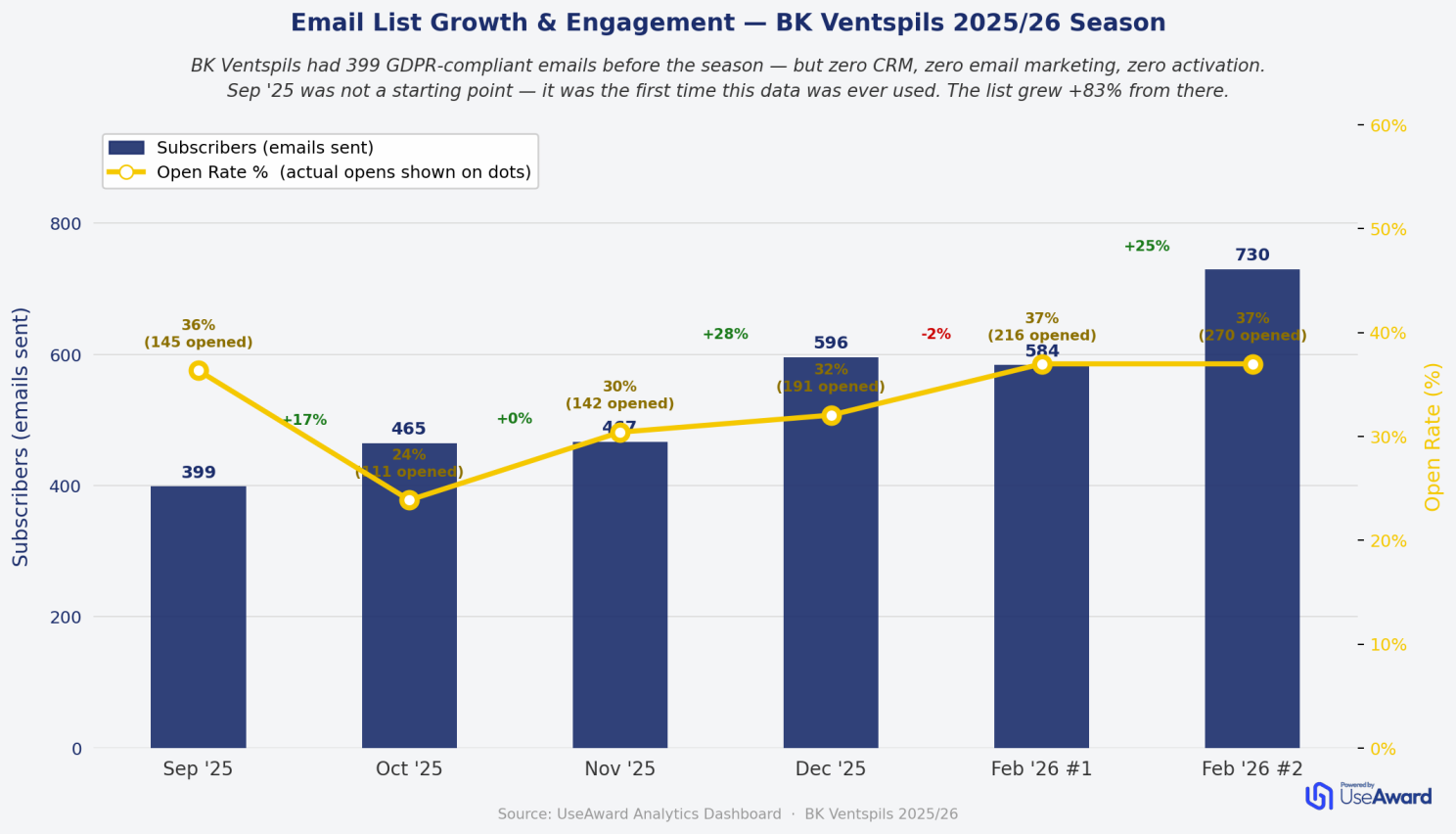
Key insight: the open rate dipped in October as new, less-engaged META leads entered the list, then recovered and stabilised above 32% as those subscribers self-selected through ongoing engagement. A healthy, self-cleaning list.
Anrijs: Let’s talk about sponsors. You mentioned at the start that sponsors want to know whom they’re reaching. Did this season change that conversation?
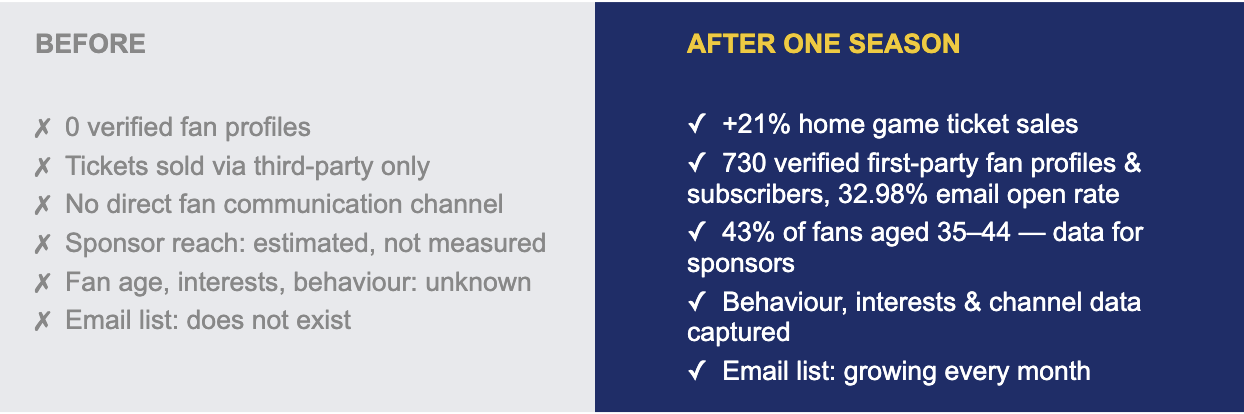
Ralfs: Significantly. Before, a sponsor conversation was essentially: we have X fans in the arena, here’s an estimate of reach. Now I can show them demographic data — 43% of our engaged fans are aged 35 to 44, the primary earning and spending demographic. I can show them email open rates, click behaviour, and the channels fans are active on. That’s a different quality of conversation. Sponsors aren’t buying logo placement anymore; the smart ones are buying access to a known audience. We can now prove what that audience looks like.
“Sponsors aren’t buying logo placement anymore — the smart ones are buying access to a known audience. We can now prove what that audience looks like: 43% aged 35–44, 32.98% email open rate, active across arena, social, and broadcast.”
Anrijs: The headline result is a 21% increase in home game ticket sales. How do you attribute that to UseAward specifically?
Ralfs: I’m careful about attribution; we did other things that season, too. But what I can say is that we had a direct email list for the first time, and we used it to send targeted ticket offers to people who had already demonstrated they cared about the club. The click-through on ticket links in the newsletters was meaningful. We weren’t spraying and praying; we were reaching people who’d raised their hands. That’s a different kind of marketing, and the results reflect it.
“UseAward helped us turn fan engagement into real data — and contributed to a 21% increase in home game ticket sales.”
Anrijs: The email data also showed store link clicks in December — fans were already buying through the newsletter. Did you feel you fully exploited that?
Ralfs: Honestly? No. And that’s one of my biggest takeaways from the season. We had key home games in winter, we had a warm, opt-in list with an 11.51% click rate, which I’ve since learned is more than double the sports e-commerce benchmark, and we had fans who were clearly ready to buy. We sent one newsletter with a store link. We should have sent a dedicated merch campaign. A limited-edition item, a bundle with a ticket. That’s sitting revenue we left on the table. I think about that. This season, we won’t make the same mistake.
“We had a warm list, an 11.51% click rate, and key home games in winter. We sent one newsletter with a store link. We should have sent a dedicated merch campaign. That’s sitting revenue we left on the table, and this season, we won’t make the same mistake.”
Anrijs: What would you do differently in year two beyond the merch opportunity?
Ralfs: Start earlier in the season, run more in-arena activations, and use the data we have now to segment properly. We know from META that 43% of our engaged fans are aged 35-44. That tells us something about messaging, about which sponsors are the right fit, and about when to run promotions. We also want to go deeper into the prediction game format. The non-betting mechanic is interesting because it keeps fans engaged throughout the entire event, not just one scan moment. And we want to treat the email list as a proper commerce channel, with seasonal drops, exclusive subscriber offers, not just match announcements.
“43% of our engaged fans are aged 35–44. The email list is a proper commerce channel now; seasonal drops, exclusive subscriber offers. Not just match announcements.”
Anrijs: The META campaign data revealed something that genuinely surprised you — the age breakdown of your fanbase. What did you see, and why did it matter?
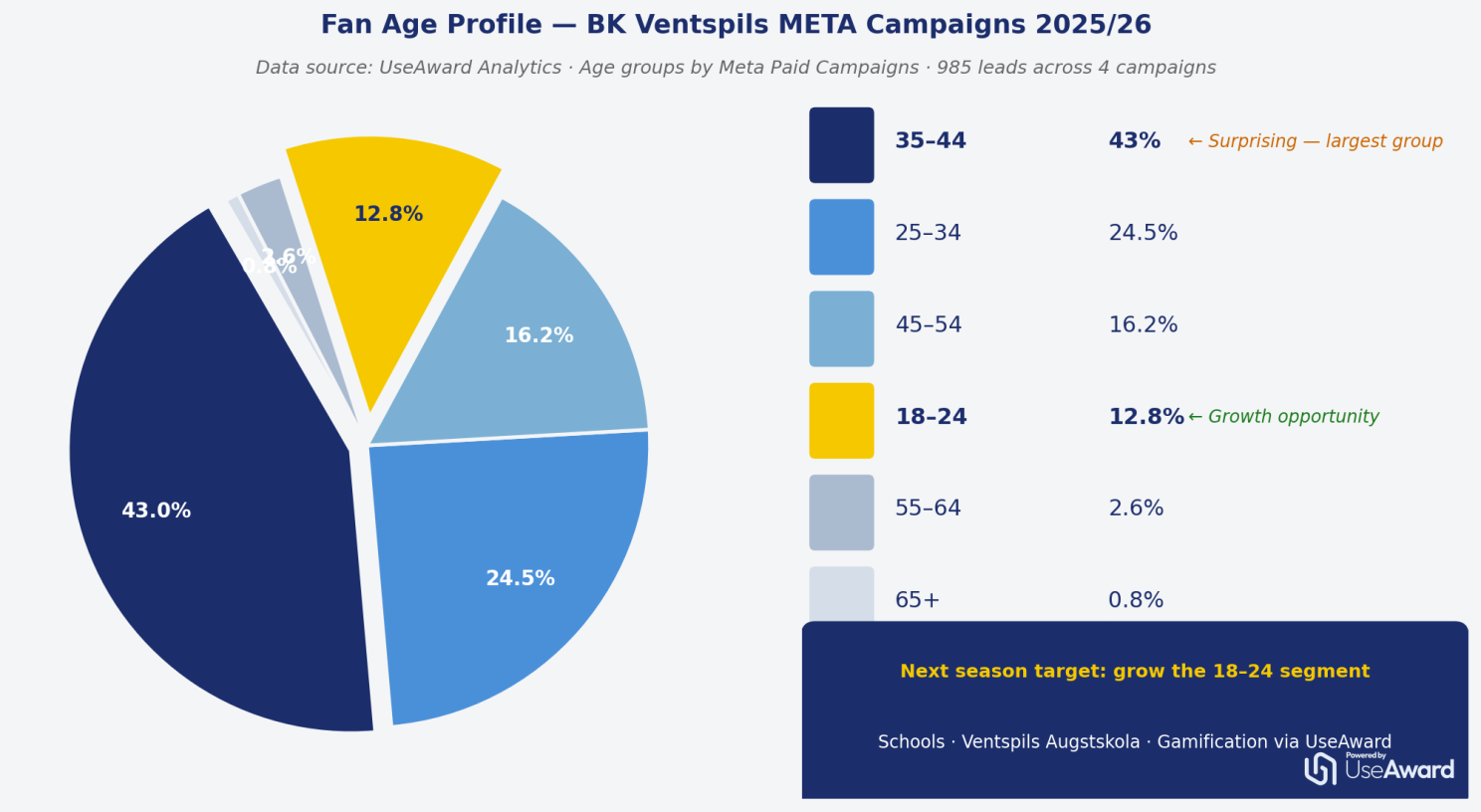
Ralfs: I expected our most engaged fans to be younger, the 18-to 24-year-old group, students, the energy you see in the arena. But the data told a completely different story. 43% of fans who engaged with our campaigns were aged 35 to 44. That’s the largest single group by a wide margin. It was a reality check. We have a loyal, established adult fanbase, which is actually very good news for sponsors and ticket revenue. But it also raised an uncomfortable question: where are the young fans? Where is the next generation of BK Ventspils supporters?
“I expected our most engaged fans to be young. The data said 43% were aged 35–44. That’s great for sponsors — but it raised an uncomfortable question: where is the next generation of BK Ventspils supporters?”
FAN AGE PROFILE — META CAMPAIGNS 2025/26
Age breakdown across 985 leads from 4 META paid campaigns. The 35–44 group dominates at 43% — the primary earning and spending demographic, strong for sponsor conversations. The 18–24 segment at 12.8% signals the strategic gap for season two.
A note on this data — Anrijs Brencāns UseAward
The age profile above reflects META paid campaigns only, one of three channels we ran for BK Ventspils this season. Fan data was also collected through organic posts on the club’s own Facebook page and through the LED screen activations inside the arena. Each channel reaches a different audience at a different moment. The full cross-channel picture is richer than any single source shows.
For next season, we will run full segmentation and analysis across all data sources — not just META. This is where FanApps’ IBM Silver Partnership becomes a real advantage. As an IBM Silver Partner, we are eligible to use IBM’s AI and analytics technologies to build deeper audience models: cross-channel behaviour, interest mapping, and trend tracking over time.
The goal is to move from knowing who your fans are to predicting what they need next, and acting on it before the competition does.

Anrijs: So the data identified a gap; the 18-to 24-year-old segment is underrepresented. What’s the plan to change that, and where does UseAward fit?
Ralfs: It’s a priority for next season. We’re looking at schools, at Ventspils Augstskola — the university here, as entry points. Young fans don’t engage the same way as a 40-year-old. They want interaction, competition, and something to share with friends. That’s where gamification becomes the strategy, not just a tactic. UseAward has features built exactly for this: leaderboards, point systems, and challenges that run across the season, not just one game. The idea is that a student scans a QR code at a game, enters a prediction challenge, competes with their classmates, accumulates points, and wins something meaningful. That journey builds a habit. And once you have their data, you can segment them separately, understand what they respond to, and show the trend over time: Are we growing this group? Are they converting to ticket buyers? UseAward lets us measure all of that.
“Young fans want interaction, competition, something to share with friends. Gamification isn’t just a tactic — it’s the strategy for the 18–24 segment. Leaderboards, season-long challenges, points that mean something. UseAward lets us build that journey and measure whether it’s working.”
Anrijs: Last question. What would you say to a GM at another club who is still sitting on the fence — maybe thinking they don’t have the time, or the team, or the budget for this?
Ralfs: I know exactly what they’re thinking, because I was thinking it too. We’re a basketball club; our job is basketball. We don’t have a data team. We don’t have a tech department. And the season is relentless. But here’s what I’d tell them: this is not a tech project. UseAward did the heavy lifting on the setup. Our team learned by doing, not by training for months first. The first activation was running within days. And the cost of not doing it is invisible — you just keep not knowing who your fans are, and your sponsors keep paying for reach you can’t prove. That invisibility has a price. You just don’t see the invoice until a sponsor walks away.
“The cost of not doing it is invisible, you just keep not knowing who your fans are, and your sponsors keep paying for reach you can’t prove. That invisibility has a price. You just don’t see the invoice until a sponsor walks away.”
Anrijs: And on a personal note — what are you most excited about digitally going into next season?
Ralfs: Honestly, the segmentation. We spent this season building the foundation, collecting data, growing the list, and learning what works on which channel. Next season, we actually get to use it properly. We know our 35-to 44-year-old audience well now. We’re going after the younger segment with gamification. We’re going to run the email list as a real commerce channel. And with the IBM analytics capability coming in through UseAward, we’ll be able to track trends across the full season, not just campaign by campaign. For the first time, I feel like we’re going into a season with a digital plan, not just a sporting one. That’s new for us. And it changes everything about how we talk to fans, sponsors, and partners.
“For the first time, we’re going into a season with a digital plan — not just a sporting one. That changes everything about how we talk to fans, sponsors, and partners.”
ABOUT USEAWARD
UseAward is an Engagement-as-a-Service platform built for sports organisations that want to turn anonymous fans into measurable first-party data. Through quizzes, prediction games, and MVP votes, deployed via QR codes, arena screens, broadcasts, and social media — UseAward captures fan profiles, tracks engagement in real time, and feeds the data directly into CRM and email marketing systems.
Clubs and leagues use UseAward to grow their email lists, segment fans by behaviour and interest, activate sponsors with proven audience data, and drive ticket and merchandise sales through targeted campaigns. Setup takes days, not months, and UseAward works hand in hand with the club team throughout.
FanApps, the company behind UseAward, is an IBM Silver Partner — eligible to leverage IBM AI and analytics technologies for advanced fan segmentation and trend analysis.
Anrijs Brencāns · Founder and CEO , Fan Apps/ UseAward